

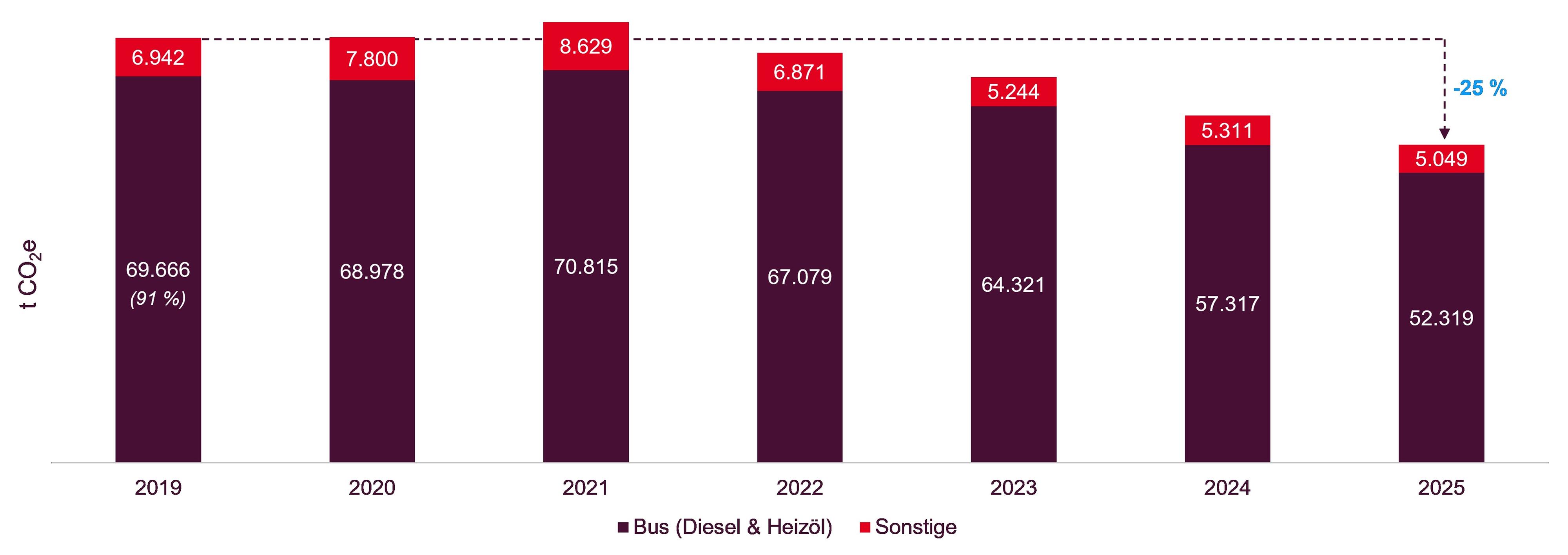
This is how we reduce greenhouse gas emissions and save energy:

Electricity from renewable sources
Our electric buses and underground trains are powered by electricity from renewable sources. This electricity is backed by guarantees of origin and comes 100 per cent from plants that do not currently receive any subsidies. Furthermore, at least 25 per cent of the electricity comes from newer plants (six years old or younger). In this way, we are continuously improving our energy use and reducing greenhouse gas emissions during operations.

Electric buses and service vehicles
We are gradually replacing our combustion-engine buses with electric vehicles. Around 430 production-ready electric buses are already in service in our fleet (as at the end of 2025). Around 240 further electric buses are set to be added by 2031. As an interim solution until full electrification is achieved, we are also using HVO100 as fuel for our combustion-engine buses. Our fleet of service vehicles is also set to be battery-powered in future.

Flywheel storage
Our modern underground trains feed up to 40 per cent of the energy generated during braking back into the traction power supply network. Other underground trains can draw on this energy when pulling away. And if there is no underground train in the vicinity that can utilise this energy, it is stored. With the help of the two flywheel storage systems, we save an average of over 700,000 kilowatt-hours of energy per year.
Inverter
Inverters utilise unused braking energy from the underground and convert it into electricity. We have one such inverter at our substation at the Rauhes Haus stop on the U2 line. The electricity can be used directly to power appliances in the immediate vicinity, such as lighting or escalators at stations. If the energy is not required there, it is fed into Hamburg’s public electricity grid. Since the system came into operation in March 2020, around 4.2 million kWh of braking energy will have been converted into electricity by the end of 2025. This is equivalent to the amount of energy needed to make around 140 million cups of coffee.

Escalators
Our escalators save no less than 140,000 kWh a year thanks to shorter run-on times. After all, once there are no more passengers using the escalator, there’s no need for it to keep running.
LEDs at bus stops
The electricity we have saved each year since 2019 by using LEDs instead of fluorescent lamps is enough to power 740 households in Hamburg for a year. The replacement schemes we have been carrying out since 2018 at bus stops, depots and workshops have resulted in a saving of 2.96 million kilowatt-hours of electricity.

Heating and Cooling
By gradually replacing fossil-fuel boilers in our existing buildings and installing only heating systems powered by renewable energy in new builds, we are reducing our emissions from heating and cooling our operational and administrative sites.
Emissions over which we have indirect influence
In addition to the greenhouse gas (GHG) emissions over which we have direct control through our actions, indirect emissions from our value chain are also highly significant. For example, when we purchase products and services or construct our infrastructure, greenhouse gas emissions arise as a result of our contracts, the use of raw materials, product manufacturing or the use of fossil fuels in the provision of services.
In accordance with municipal guidelines, group-wide greenhouse gas emissions from the upstream and downstream value chain (Scope 3) are to be reduced by at least 25 per cent by 2030 and by at least 90 per cent by 2040, compared with the base year 2024. Should the reduction target prove unachievable by 2030, an alternative target may be set, for example with a focus on supplier management.
HOCHBAHN has therefore been measuring its Scope 3 GHG emissions since 2024 and has found that these account for a large proportion – just under 75 per cent – of total emissions. Upstream emissions from procured products and services are of particular significance. In this area too, we are implementing measures to reduce our greenhouse gas emissions:
Construction of the U5
Underground Line 5 is set to set new standards. As Hamburg’s first fully automated underground line, with a frequency of up to 90 seconds, it will naturally set new standards in terms of service, but also in the construction phase itself. We have set out to systematically take into account the greenhouse gas emissions generated during the construction of the U5 and to reduce them as far as possible. To this end, the planning process takes into account not only the construction processes but also the supply chain. You can find out more about the U5 and our reduction strategy here.

GHG-reduced building materials
In order to reduce the emissions associated with the construction of our buildings, various options are being examined and, in some cases, have already been implemented. For example, low-carbon steel was used for the roof structure of the Harburg Central Bus Station (ZOB); according to the environmental product declaration, its production – using green electricity and the electric arc process – resulted in emissions of just 299 kg CO₂e/t instead of the usual 688,299 kg CO₂e/t. At the Meiendorf depot, the roof structure of the carports was built from timber for the first time. And at the Langenfelde bus depot, the staff building is being constructed with a rear-ventilated timber facade.

Procurement criteria for selected products
For selected, emission-intensive products, such as vehicles and charging infrastructure, HOCHBAHN applies award criteria in its procurement processes and contract terms to ensure transparency regarding the products’ GHG emissions during manufacture and to increase the proportion of primary data used in the GHG assessment. As part of the tender evaluation process, factors such as the use of green electricity, energy management systems and strategies for using recycled materials are viewed favourably for such products. Information from upstream supply chains may also be taken into account, particularly in the case of batteries.
E-buses
More than 400 electric buses are already in service. How HOCHBAHN is further developing its bus fleet, infrastructure and fuels ...
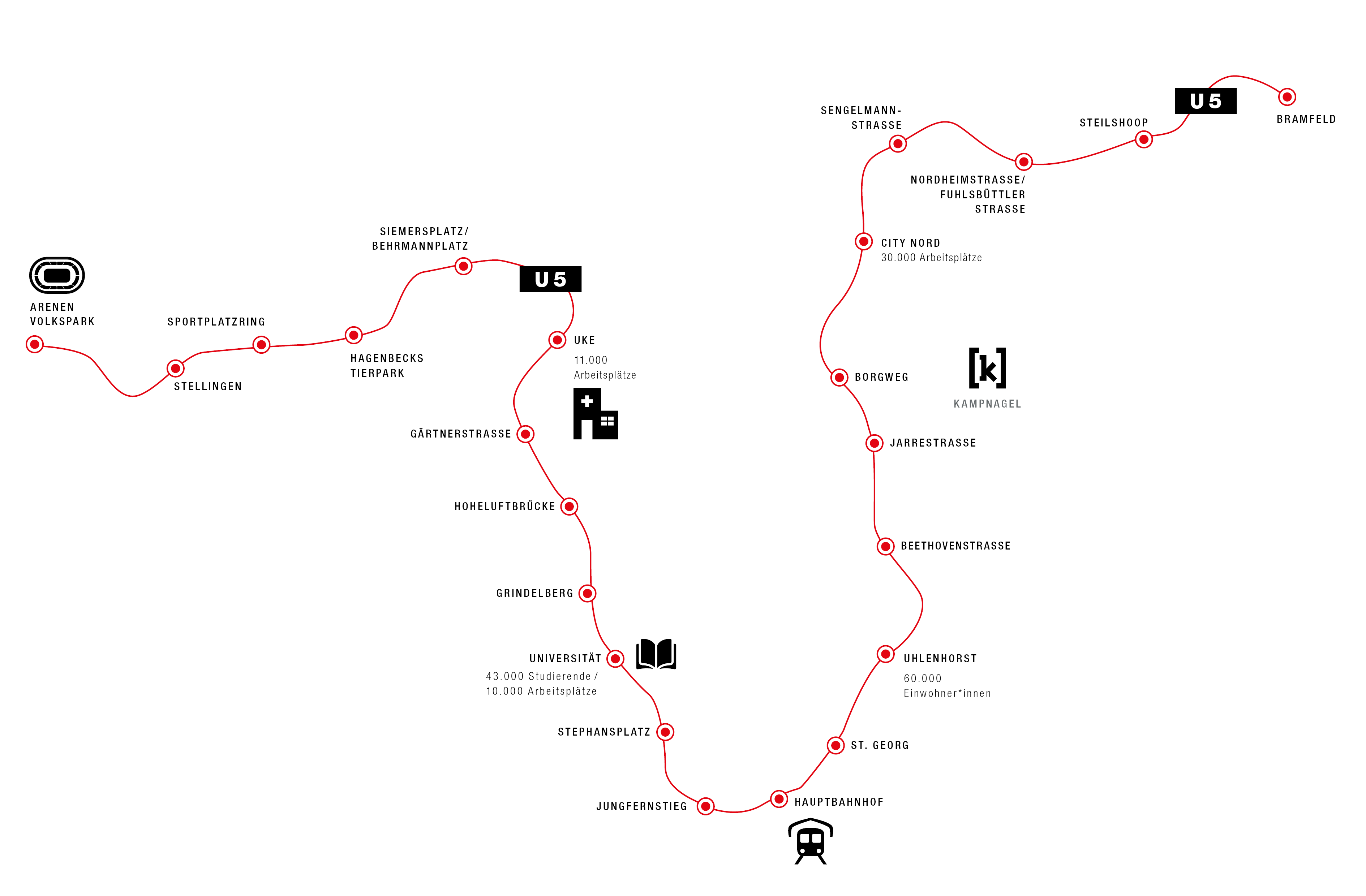
Underground expansion for Hamburg
U3, U4, U5: HOCHBAHN is extensively expanding its underground network to ensure that the mobility revolution succeeds and people can get around the city more quickly.
We stand up for our city and its people
We move more than 1.2 million people across Hamburg every day. It's clear that we have a special responsibility for the people of this city and our team.