

The 2035 strategy at a glance:
Performance and quality
The ongoing maintenance and modernisation of our underground and bus systems ensure the long-term reliability and cost-effectiveness of our services and reinforce fundamental quality criteria such as punctuality and safety.
Measures to achieve this include:
Underground maintenance and modernisation:
To ensure that all work on the underground network runs smoothly, it must be well coordinated. HOCHBAHN has therefore developed a special planning procedure that highlights the interdependencies of long-term projects. This central tool enables the maintenance and modernisation of the network to be professionally planned many years in advance and then implemented.
The barrier-free expansion of underground stations is expected to be completed by the end of the 2020s. We are also introducing a new generation of underground trains with the DT6. We will be able to procure up to 370 DT6 trains by 2045.
New bus facilities:
The bus interchange facilities in Harburg and Rahlstedt have been undergoing expansion and reconstruction since 2024 to create efficient transfer points. Further facilities are in the planning process to increase capacity.
Battery-powered buses:
HOCHBAHN is consistently upgrading its bus fleet and reducing its reliance on fossil-fuel-powered vehicles. Since 2020, the majority of buses procured have been battery-powered. At the same time, HOCHBAHN has responded to the significantly longer service life of the current buses and will continue to use them for up to 15 years in the future. Our diesel buses will also be gradually converted to HVO (hydrotreated vegetable oils, a synthetic diesel fuel made from hydrogenated vegetable oils or other biogenic residues).
Safety in public transport:
Improving safety in public transport is a clear goal for HOCHBAHN. Together with HOCHBAHN-WACHE, the presence of security personnel at stops, in vehicles and in the vicinity of busy locations will be further expanded. At the same time, HOCHBAHN will test technological options to enhance objective safety and passengers' sense of security. A pilot project is working on an AI application that recognises patterns in video images from underground stations and automatically reports potentially safety-critical incidents to the operations centre.
In this way, we want to improve the quality of the passenger experience and strengthen passengers' sense of safety in the long term.
Expansion and transformation
Strong public transport in Hamburg is based largely on significant expansion, which closes gaps in the city area with a diverse and flexible range of services. Technological developments in mobility will significantly increase the attractiveness of the services on offer.
Measures include, for example:
Rail expansion:
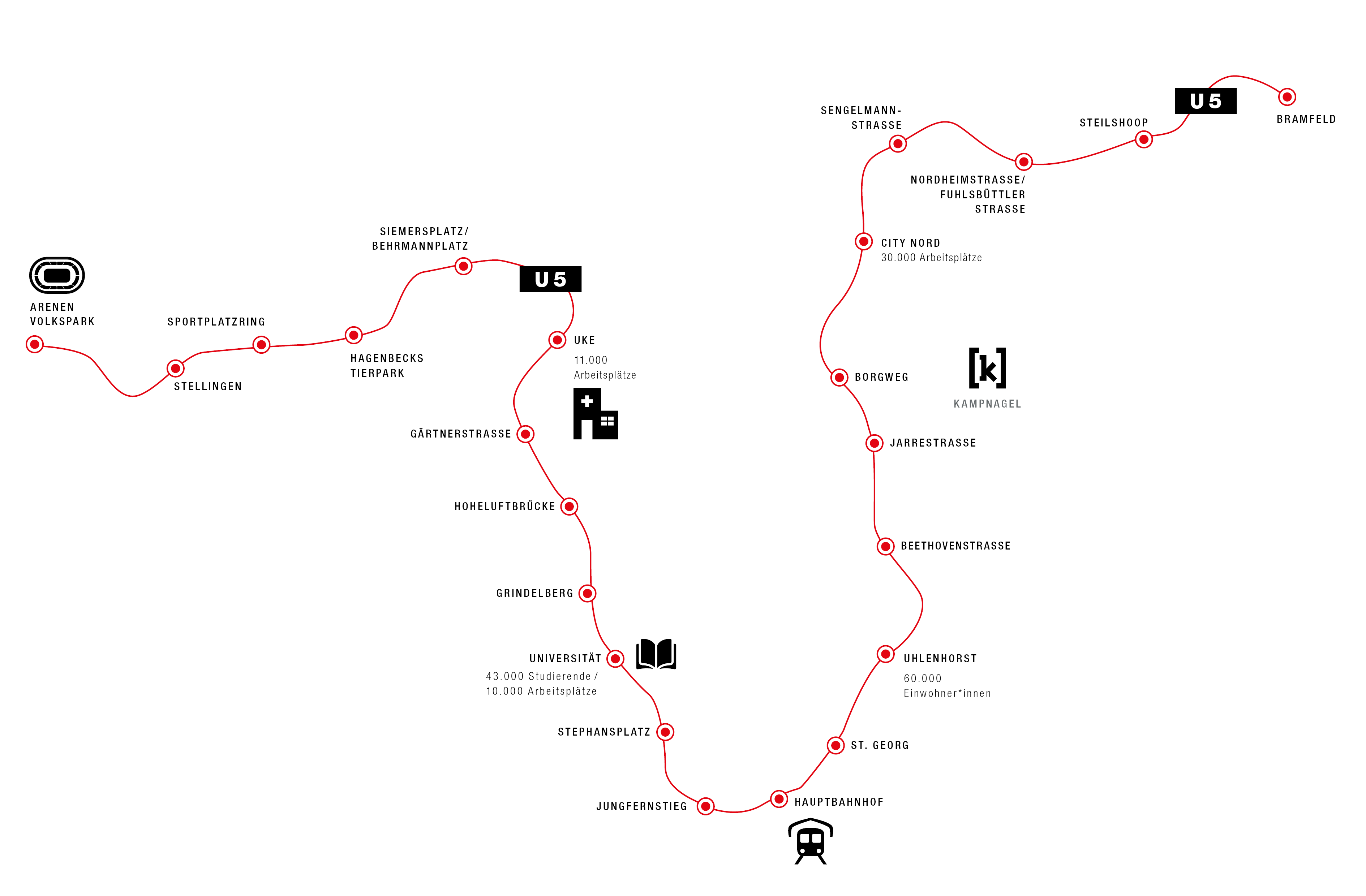
The extension of the U4 to Horner Geest is under construction, as is the first section of the new, fully automated U5 from Bramfeld to Borgweg. By 2040, the U5 is expected to run across the city to the arenas. The extension beyond that to Osdorfer Born is also expected to be completed around 2040. Sections of the U5 will go into operation before the entire line is completed, creating numerous new and faster connections at an early stage with connections to the U1 and U3.
The new Grasbrook district, with around 3,000 apartments and 16,000 jobs, will also be directly connected to the U4. To this end, HOCHBAHN is developing transport planning concepts that will effectively meet Hamburg’s growing mobility needs. After all, Hamburg’s mobility transition can only succeed with a robust underground system.
Underground automation:
In addition to the fully automated U5, HOCHBAHN is implementing partial automation on the U2 and U4 lines (U-Bahn100 project). The digitalisation of the track and rail will enable automatic driving in GoA2 (Grades of Automation) mode. To this end, HOCHBAHN will use completely new train control technology that will enable a cycle time of just 100 seconds.
Optimisation of bus services:
Optimising bus services and increasing the attractiveness of this mode of transport is particularly important in Hamburg. We are therefore fundamentally redesigning the Hamburg bus network in order to achieve greater efficiency for further expansion. Our goal is to create even more attractive travel times for a large number of passengers and to open up additional areas in Hamburg.
Autonomous driving:
HOCHBAHN sees autonomous bus transport as a key lever for attracting even more people to public transport while making the service even more attractive and efficient. That is why we are developing and testing driverless bus services in various application scenarios.
Customer experience
Mobility requirements are changing. That is why it is important to focus on the needs and wishes of customers. This is the only way to create an attractive offering. Customer service must be simple, intuitive and reliable. Fast, real-time information is just as important. Well-connected mobility services provide greater flexibility. They enable public mobility that is tailored to individual needs.
Networking public mobility:
HOCHBAHN has been successfully shaping public mobility in Hamburg for years and, as an organiser, makes as many forms of mobility and providers as possible digitally combinable via the hvv switch app. Bundled access will increasingly break down the boundaries between individual services and make it much easier for people to get around. The technical basis for this is MOSAIC, HOCHBAHN's Mobility-as-a-Service platform.
Information and payment:
HOCHBAHN is developing new, simple and personalised services. Real-time location data for buses has already been integrated into the hvv switch app, with information on capacity utilisation and disruptions to follow. Occasional passengers will be offered simple payment options without the need for an app or ticket machine. Digital assistants could provide passengers with multilingual advice at stops.
Customer-focused planning:
The population is changing – older people are staying active longer, while at the same time many young passengers are using public transport. HOCHBAHN is developing its services to meet the diverse needs of all groups – from barrier-free access to attractive offers for schoolchildren and young people. To this end, we are establishing regular passenger surveys and measuring customer satisfaction. On the one hand, this will enable us to continuously review the quality and performance of HOCHBAHN. On the other hand, it will allow us to respond to changing expectations and demands in a timely manner.
Transformation of the world of work
The changing world of work is characterised by increasing digitalisation, in particular the growing use of artificial intelligence. At the same time, HOCHBAHN must deal with the challenges of demographic change. Shaping the generational change and promoting digital literacy among the workforce requires the further development of corporate and leadership culture. To this end, we have defined the following strategic measures:
Skilled workers for the mobility transition:
Demographic change poses major challenges for HOCHBAHN: in the coming years, many experienced employees, particularly in driving services, technology and skilled trades, will be retiring. In order to ensure reliable operations in the future, HOCHBAHN is specifically expanding its workforce and developing succession plans.
Expanding digital skills:
The networked world of work requires the development and expansion of digital skills across the entire workforce. HOCHBAHN will launch initiatives to enable employees to build the necessary skills and provide appropriate guidance on changes in job profiles. In this way, we ensure that new digital workplaces are efficient and increase productivity.
Diversity strengthens HOCHBAHN:
HOCHBAHN is committed to diversity and equal opportunities. Our vision is that HOCHBAHN should be as diverse in the composition of its workforce as the city we serve and for which we develop tailor-made mobility solutions. Diversity is therefore expressly valued, desired and actively promoted at HOCHBAHN.
This vision is underpinned by our clear stance:
• The diversity of Hochbahn employees is our strength. It drives innovation and quality.
• In our working environment, all Hochbahn employees can and should develop their different potential.
• Appreciating diversity is a core corporate value for HOCHBAHN – both economically and culturally.
Sustainable corporate development
At HOCHBAHN, sustainable corporate development means responsible management and control of the company. The focus is on sustainability, economic stability and fulfilling our mission as a public service provider.
Responsibility for climate protection:
HOCHBAHN shapes mobility for the people of Hamburg and, as a municipal company, takes responsibility for reducing greenhouse gas emissions. Our services help to prevent greenhouse gas emissions from transport and thus contribute to achieving the City of Hamburg’s climate targets. At the same time, we are working internally to integrate these issues across all areas of the company, for example through energy management or improved supplier management.
Transparent management:
As a public company managed according to private-sector principles, the efficient use of publicly provided funds is both a requirement and an expectation for HOCHBAHN.
A company-wide key performance indicator system, the Erfolgskompass (Eng: Success Compass), shows how HOCHBAHN is developing in areas such as economic efficiency, quality, sustainability and customer satisfaction. The key performance indicators are uniformly defined and presented in an easily understandable way. They have also been available to the public since September 2025.
High priority for cyber security:
Cyber security is a top priority for HOCHBAHN as part of the public infrastructure. As an operator of critical infrastructure, we are committed to protecting our systems and data from cyber threats in the long term. We pursue a clear strategy: resilient systems, continuous improvement and the training of our employees. In doing so, we adhere to recognised security standards and modern security concepts. This is how we create the basis for secure, digital and resilient mobility – today and in the future.
Current projects of HOCHBAHN
E-buses
More than 400 electric buses are already in service. How HOCHBAHN is further developing its bus fleet, infrastructure and fuels ...
Autonomous on-demand shuttles
HOCHBAHN will soon be operating autonomous on-demand shuttles in Hamburg. The ALIKE project was established with other partners for this purpose.
Underground expansion for Hamburg
U3, U4, U5: HOCHBAHN is extensively expanding its underground network to ensure that the mobility revolution succeeds and people can get around the city more quickly.
Barrier-free expansion
More than 90 percent of our 93 underground stops have now been refurbished, have (partially) elevated platforms and a tactile guidance system for blind and visually impaired people. Now a few more "heavyweights" are to follow on the road to accessibility.
New bus depots
Bus depots for electric transport: Following Alsterdorf, a new HOCHBAHN site is now being established in Meiendorf. More will follow.